



































When looking at a company, many numbers can be made to “tell a consistent story.”
A 15% revenue increase can be interpreted as robust business growth; a 60% debt-to-asset ratio does not seem alarming; positive operating cash flow apparently signals that the company can still generate healthy cash.
But from another angle, the exact same numbers can tell a very different story.
If the industry average growth rate is 35%, then 15% is no longer “growth”; it is falling behind. If a 60% debt ratio masks a much higher proportion of short-term debt than peers, then “not alarming” becomes a structural problem. If operating cash flow is positive yet has been narrowing for three consecutive years, while receivables are consistently growing faster than revenue, the quality of that “positive” number deserves serious scrutiny.
The problem is not the data itself. A single data point in isolation makes it almost impossible to judge what it really means. Good or bad, high or low, normal or abnormal: these assessments fundamentally require a frame of reference.
Without a frame of reference, data remains just numbers, not information.
So, what exactly should we examine when evaluating a company?
Enterprise Assessment: From Single Indicators to a Complete Understanding
Revenue, profit, debt-to-asset ratio, cash flow… these metrics are important, of course, but they are far from sufficient to fully define a company.
To truly understand a company, you need to know much more:
Who is it, and what entities and relationships constitute it?
What is its main business, and what kind of industry and sector environment does it operate in?
Is its operational foundation stable? Is its financial structure healthy?
Which companies is it connected to, and where could potential risks originate?
Even more importantly, from the perspective of different financial business lines, which information deserves the most attention?
These questions all point to the same conclusion: the first step in evaluating a company is not to assign a score, but to understand the enterprise as completely as possible.
This is precisely the starting point of the FundeLight product framework.
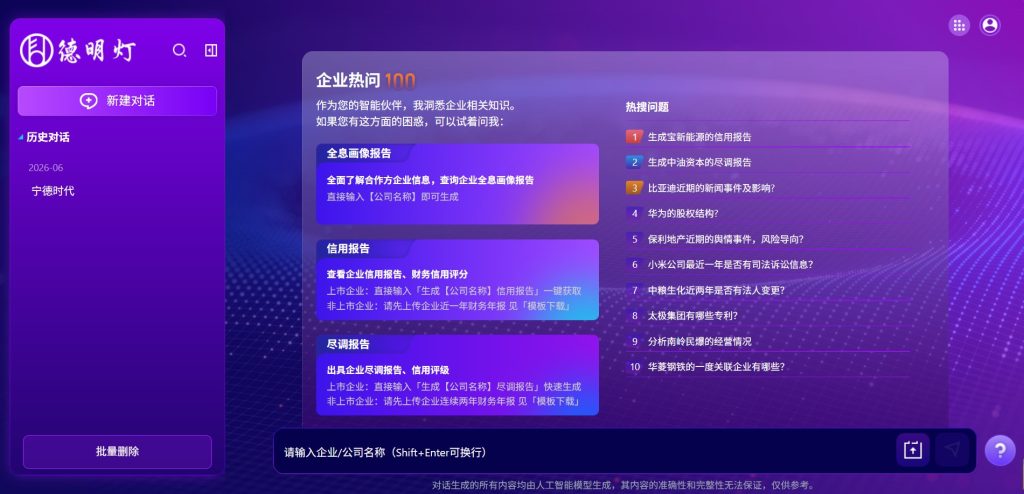
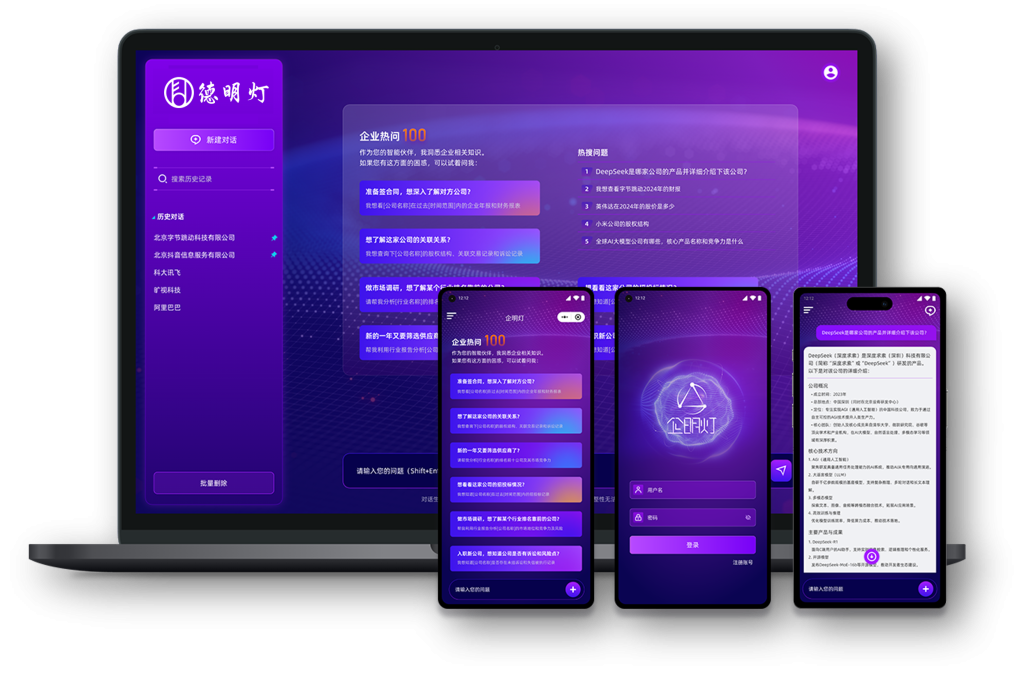
FundeLight is positioned as an AI Financial Terminal. It is neither a single-dimension enterprise scoring product nor a credit assessment tool focused only on financial metrics.
At the technological level, FundeLight uses “AI + Ontology” as its underlying data tool platform, deeply integrating the semantic understanding capabilities of Large Language Models (LLMs) with the logical reasoning power of Large Mathematical Logic Models (LMLMs). Using an ontological framework as the organizational backbone, it constructs a panoramic, holographic portrait of an enterprise through all-dimensional information. This foundation enables FundeLight to flexibly invoke corresponding dimensions of data and reasoning logic for different financial scenarios, providing precise support for all types of financial analysis.
The technology powering FundeLight comes from FundeAI, a technology company born from Funde Group’s digital and intelligent strategy and AI industrialization roadmap. Targeting “industrial intelligence,” FundeAI has built its foundational technological capabilities around four core pillars:
- Computing Power: Fortifying the infrastructure for intelligent computation;
- Algorithms: Powering the core engines for semantic understanding and logical reasoning;
- Data: Constructing an all-dimensional data system that connects multi-source information;
- Security: Ensuring compliance and reliability throughout the entire data and information processing lifecycle.
These four pillars together form the technological base that allows FundeLight to operate efficiently.
Built upon the enterprise holographic portrait, FundeLight establishes a unified foundation for understanding a company. It then extends this understanding into different financial scenarios, investment research, equities, and fixed income, forming a “1+3” product system.

FundeLight Product System
This product framework essentially represents the holistic framework through which FundeLight understands and evaluates a company. It can be summarized in one sentence:
“1” establishes a complete understanding of the enterprise; “3” transforms this understanding into professional judgments tailored for different financial scenarios.
The Unified Cognitive Base: Constructing an Enterprise Holographic Portrait
The starting point of the FundeLight evaluation system is the Enterprise Holographic Portrait.
This is not a static information page, nor a simple aggregation of data from business registration, finance, operations, legal proceedings, and public opinion.
Its core function is to unify and interrelate information scattered across different sources and dimensions around the enterprise entity, forming a relatively complete and structured understanding of a company.
The scope of information that needs to be considered extends far beyond a single financial report.

FundeLight Holographic Report – Information Dimensions Covered
Basic corporate information, shareholder and equity structures, financial data, operational information, judicial and risk records, public sentiment dynamics, intellectual property, affiliated companies, and relationship networks: these dimensions collectively form the basis for understanding a company.
A single financial statement can only present one facet of an enterprise. What the Enterprise Holographic Portrait seeks to answer is not merely “what information exists about the company,” but more importantly, “what are the relationships between these pieces of information?”
Unlike approaches that rely solely on linguistic models for text understanding and generation, FundeLight, through its LMLMs, introduces structured reasoning and logical modeling capabilities. This allows the correlations, constraints, and transmission paths between enterprise information to be systematically identified and expressed, achieving a more profound and complete understanding of the enterprise.
For instance, a company’s financial statements might show stable profitability, but its affiliated enterprise map reveals close dealings with multiple entities exhibiting abnormal operations.
Or, its revenue may be growing, but judicial information indicates it is facing numerous contract disputes.
Individually, these signals do not constitute a definitive conclusion. But placed together within the same enterprise portrait, they enable a more three-dimensional judgment.
Building on the Enterprise Holographic Portrait, FundeLight further conducts financial analysis, relationship identification, risk clue discovery, and professional report generation. These capabilities collectively form the unified cognitive base that is the “1” in FundeLight’s framework.
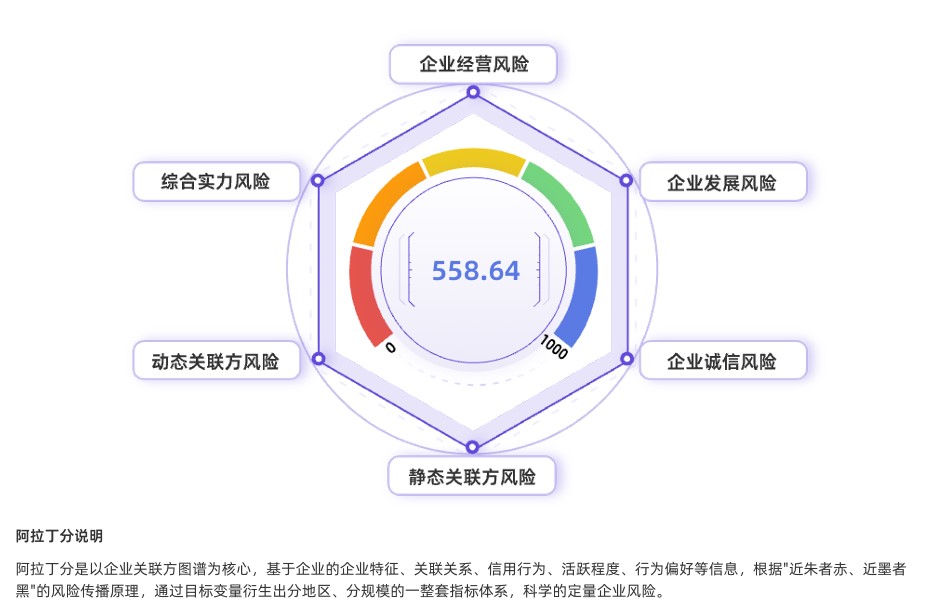
FundeLight Holographic Report – Aladdin Score
First, understand the enterprise completely. Then, discuss how to evaluate it.
This, however, is only the first logical layer of the FundeLight evaluation system.
Scenario-Based Analysis: Enterprise Judgment from Three Financial Perspectives
Once you have a complete understanding of a company, the next question is: what questions is this understanding meant to answer?
The answer depends on who is asking.
An analyst doing corporate due diligence cares about whether the enterprise is genuine, whether its relationships are complex, and whether its operational foundation is solid.
Someone working in the secondary market focuses on opportunity signals, risk indicators, capital movements, and changes in public sentiment.
A fixed-income professional watches debt repayment capacity, cash flow, credit spreads, and bond pricing.
The enterprise is still the same enterprise; the underlying facts have not changed. Yet the focal points of different financial scenarios are markedly different.
This is akin to a hospital examination report. The same person’s blood test and imaging data will be read entirely differently by an internist, a surgeon, and a nutritionist. The data has not changed; it is the difference in focus that makes the part considered “valid information” drastically different.
FundeLight’s product architecture unfolds precisely along this logic.
FD-Report is tailored for investment research and due diligence scenarios. It focuses not only on an enterprise’s financial performance but also on its industrial position, competitive strength, development trends, and potential risks, serving corporate due diligence, industry research, and investment value assessment.
FD-Security is aimed at A-share listed company analysis. On top of the foundational enterprise understanding, it layers in multi-source signals such as market data, capital flows, and public sentiment. Centered on over 60 behavioral indicators and scores, it forms the basis for opportunity identification, risk observation, and research report generation for listed companies.
FD-Fixed Income focuses on fixed income and debt instrument analysis. It concentrates on corporate entity creditworthiness, debt repayment ability, bond-specific risks, and bond pricing. It supports full-universe bond queries and yield curve analysis, displaying benchmark curves, credit curves, and OAS curves across dimensions such as maturity and credit rating.
These three directions share a single foundation: the Enterprise Holographic Portrait and unified cognitive base established by FundeLight.
Without this unified base, the three directions would merely be three isolated tools. With it, they become differentiated extensions of the same enterprise cognitive system applied to different financial scenarios.
The “1+3” Evaluation Framework: Unified Base and Professional Extensions
At this point, the relationship within FundeLight’s “1+3” framework is clear.
“1” addresses: How to first establish a relatively complete and unified understanding of an enterprise.
The Enterprise Holographic Portrait is the starting point of this phase, with financial analysis, relationship networks, risk identification, and professional report generation all being capabilities built on this foundation.
“3” addresses: When different financial business lines face the same enterprise, what should each focus on, analyze, and conclude?
FD-Report, FD-Security, and FD-Fixed Income are neither three fragmented products nor do they each start from scratch to understand the enterprise.
They share the same set of enterprise base facts and cognitive foundation. The only difference lies in invoking different data dimensions, adopting different analytical logic, and outputting professional results with different emphases based on the specific financial question at hand.
The underlying facts about a company are relatively constant, but the questions that matter differ across financial scenarios.
The “1+3” framework is designed to simultaneously satisfy both conditions: preserving the unity and traceability of enterprise cognition, while allowing each scenario to maintain its own analytical focus.
Within this framework, the Domino Score is one of the most representative capabilities among FundeLight’s numerous assessment tools.
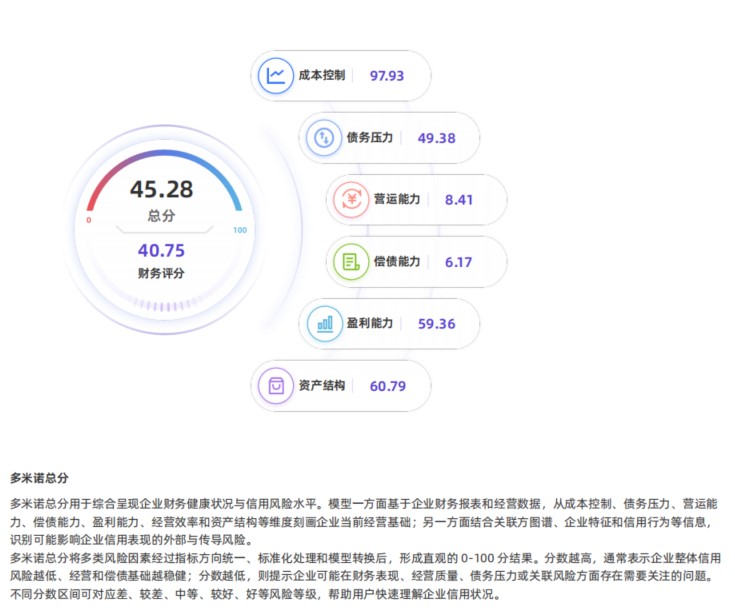
FundeLight – Domino Score
It uses a composite score from 0 to 100 to present an enterprise’s financial health and credit risk level.
On one hand, it observes the company’s operational foundation across seven dimensions: cost control, debt pressure, operational capacity, debt repayment ability, profitability, management efficiency, and asset structure. On the other hand, it integrates affiliated party maps, corporate characteristics, and credit behavior to identify external risks and contagion risks that could affect the enterprise’s credit profile.
A high or low score provides an intuitive reference, but it is merely one result derived from enterprise evaluation, not the complete definition of a company.
Behind the score, the Enterprise Holographic Portrait, financial analysis, affiliated relationship identification, and scenario-based judgment all work in concert.
The truly difficult part of financial analysis has never been the speed of information processing.
In the past, the hardest part was finding information; later, it was reading information. Now, both are being rapidly addressed by AI. Yet one enduring challenge has always remained, undiminished by technological iteration:
How can the understanding of an enterprise remain both complete and unified, while also adapting to the professional requirements of different financial scenarios?
What is needed for this is not greater computing power, nor a larger model.
It requires a holistic framework that starts from an Enterprise Holographic Portrait and progressively extends into investment research, equity, and fixed-income analysis.
Behind this lies a capability leap from Large Language Models (LLMs) to Large Logic Models (LMLMs).
LLMs empower FundeLight to efficiently comprehend vast amounts of enterprise information. Building on that, LMLMs introduce structured reasoning, enabling the systematic identification of relationships and risk transmission paths between pieces of information.
First, establish a complete understanding; then, make scenario-based judgments.
First, see clearly what the enterprise is; then, answer what it signifies from different financial perspectives.
What FundeLight aims to resolve is not finding an answer within a pre-defined question, but stepping back to see clearly how the question itself is defined.
It may seem slower, but a “slow” that points in the right direction surpasses ten thousand futile attempts at “fast.”
FundeLight currently covers over 5,000 listed companies and, starting from this base, is continuously advancing the market application of its evaluation system.
About FundeAI
FundeAI is committed to becoming a provider of digital economy infrastructure and an enabler of industrial intelligence development.
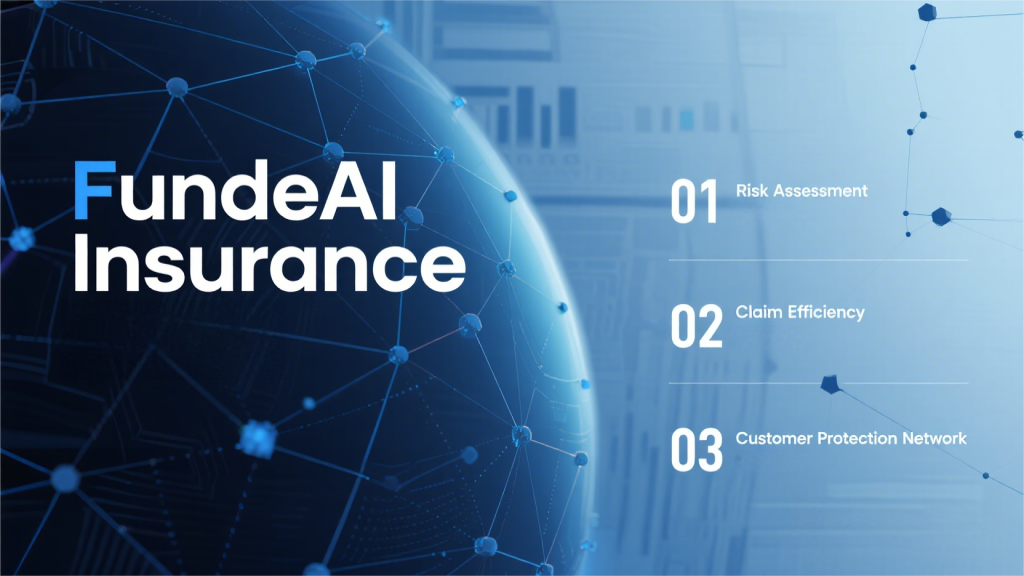
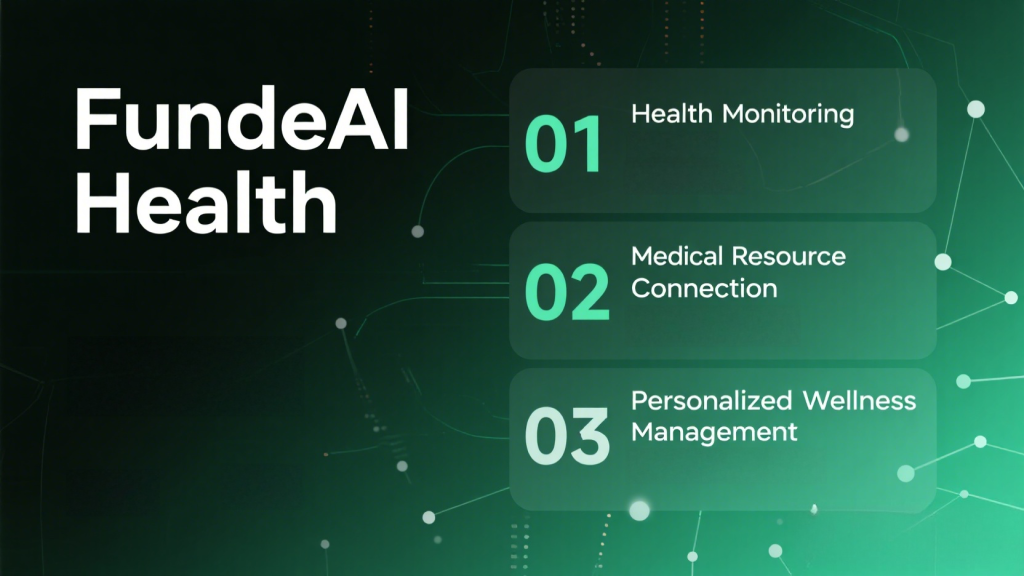
With “AI + dynamic ontology” as its technological foundation, and with “algorithms, computing power, data, and security” at its core, FundeAI serves multiple industries including financial insurance, energy and chemicals, health management, and smart government. Starting from frontier scenarios, FundeAI turns technology into practical business outcomes, helping improve risk control, efficiency, and intelligent decision-making.
We believe the value of digital intelligence lies in solving complex problems in the real world.