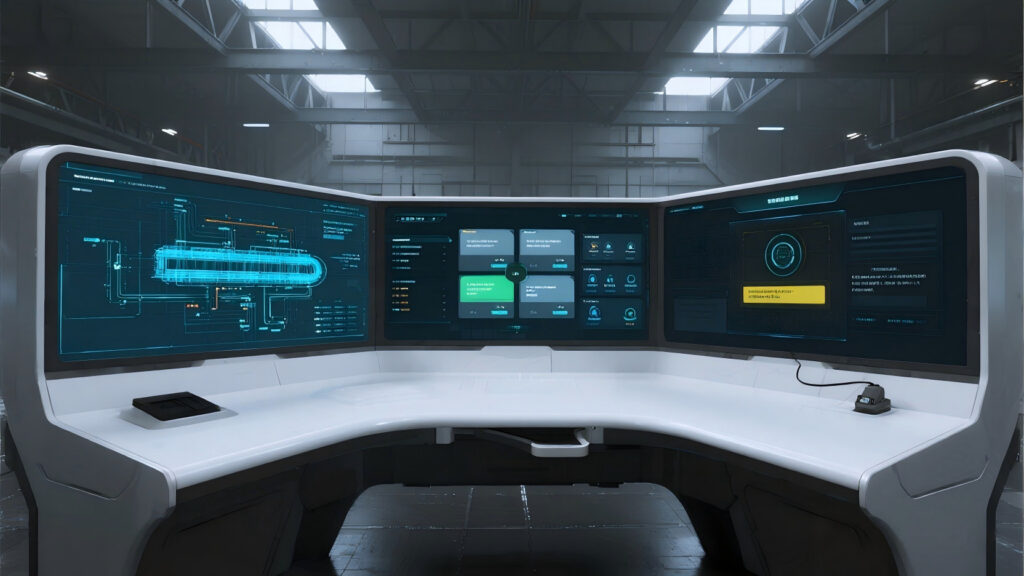
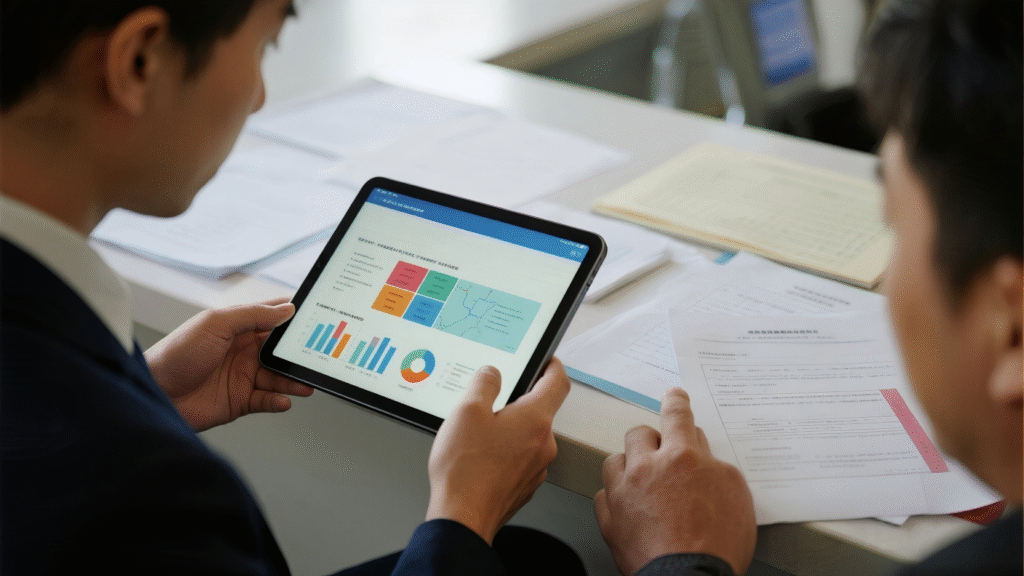
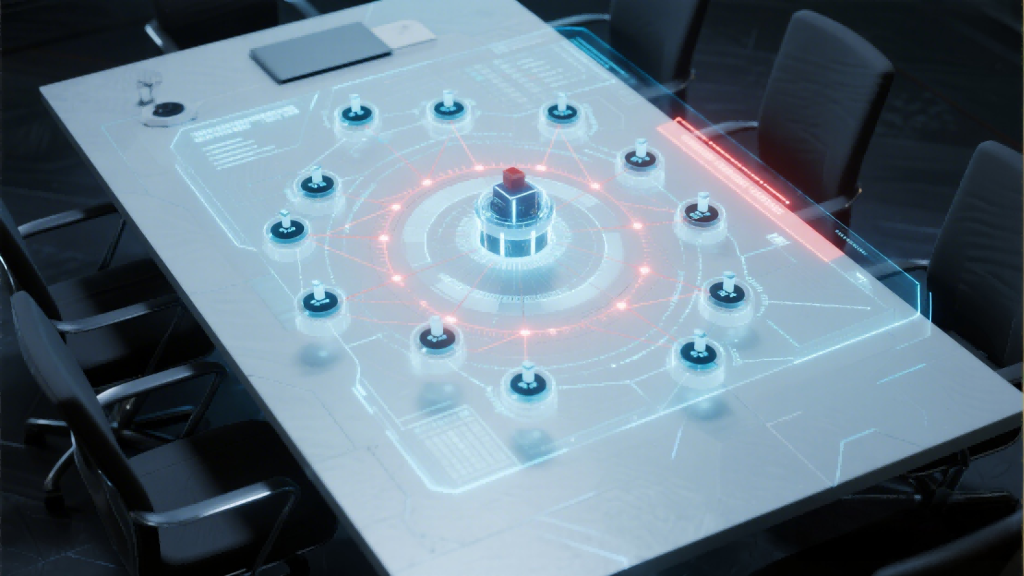
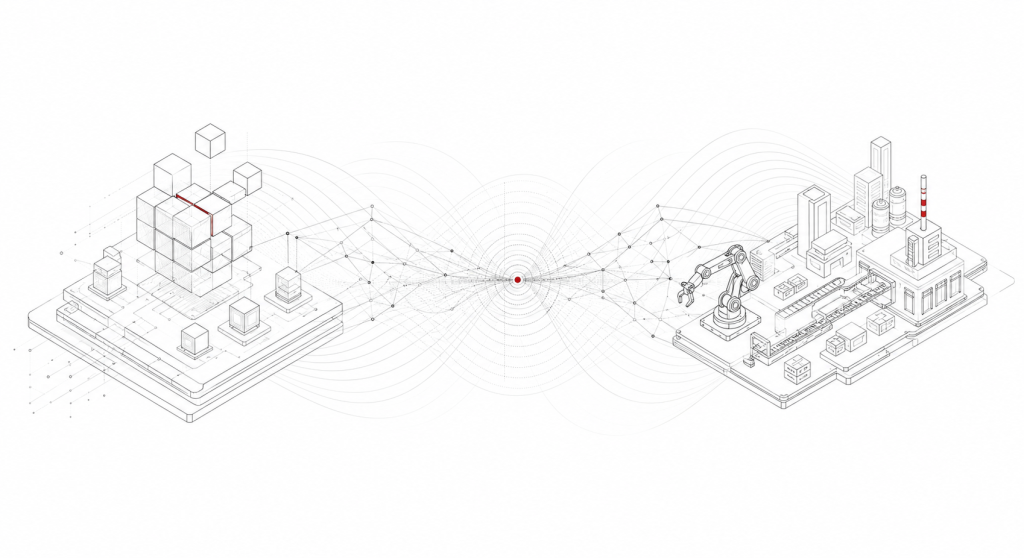
In complex business scenarios such as risk identification, compliance monitoring, business analysis, fraud detection, and industry insight, what determines the upper limit of an organization’s capabilities is not the scale of data itself, but the ability to connect event recognition, relationship judgment, conclusion output, and business execution. Based on the data base, ontology platform, large model platform, business model, and data resource platform, FundeAI has built a closed-loop event analysis mechanism for complex scenarios, promoting event analysis from result display to decision support.
In the AI era, the competitive paradigm of enterprise data capabilities is undergoing a fundamental reversal: from “who can see more data” to “who can turn data into action faster”.
——Why do the “data capabilities” of the vast majority of enterprises ultimately stop at the report level?
The answer is brutal: because there is only “seeing”, no “action mechanism”. As business structures continue to evolve, the objects faced by event analysis are no longer single problems that can be explained by a few charts or ledgers. Whether it is insurance risk control, anti-money laundering, compliance verification, abnormal customer operations, enterprise-related risks, supply chain fluctuations, public opinion disturbances, or business events, these scenarios all involve the linkage of multiple subjects, multiple links, and multi-level factors. Data is scattered across different systems, clues are hidden between different objects, and impacts continue to spread along business processes. For organizations, the real challenge is not just detecting anomalies, but being able to quickly complete judgment, collaboration, disposal, and review after anomalies occur.
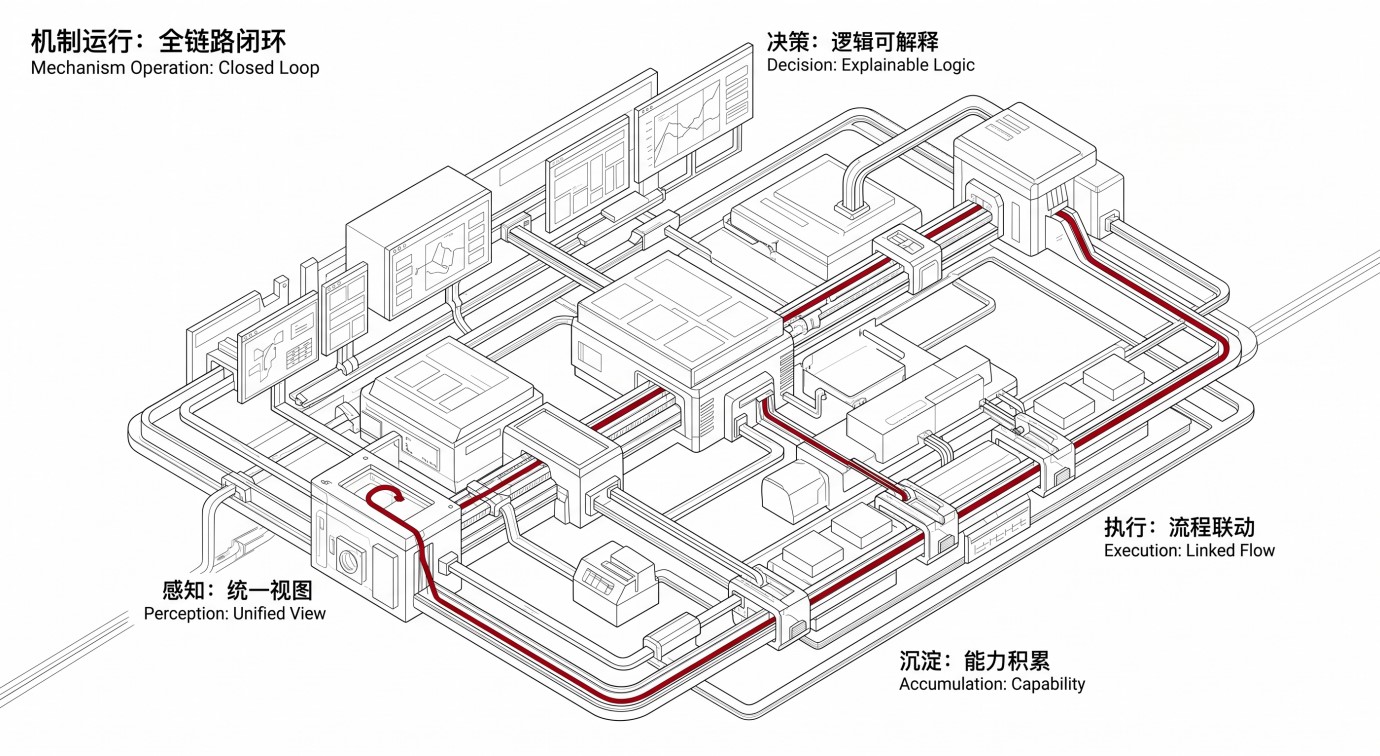
This is also FundeAI’s basic understanding of event analysis. Event analysis should not be just an analytical action, but a sustainable working mechanism. It starts with event perception, goes through data preparation, correlation exploration, in-depth verification, and decision support, and finally returns to knowledge precipitation and capability iteration, forming a complete closed loop.
Full-Link Closed-Loop Mechanism
In other words, the focus of a mature event analysis system is not on “seeing the problem”, but on “letting the problem enter the mechanism and transforming it into action through the mechanism”.
The core of event analysis is not information accumulation, but mechanism operation
In a complex business environment, simply increasing the amount of data, expanding indicators, or superimposing models does not necessarily lead to higher-quality analysis. What plays a decisive role in the effectiveness of analysis is whether a unified working mechanism has been established to connect data from different sources, judgments from different roles, and actions at different levels. Without this mechanism, event analysis can easily get stuck at several levels: First, data is scattered and it is difficult to form a unified view. Second, clues are isolated and it is difficult to reveal deep relationships. Third, judgment relies on personal experience and lacks stable methodological support. Fourth, conclusions remain in reports and cannot effectively enter business processes. Fifth, there is a lack of precipitation after disposal, making it difficult to accumulate organizational capabilities. Therefore, the construction of event analysis capabilities is essentially a systematic project. It requires not only a solid data foundation, but also clear business semantics, interpretable judgment logic, linkable execution processes, and precipitable experience results.
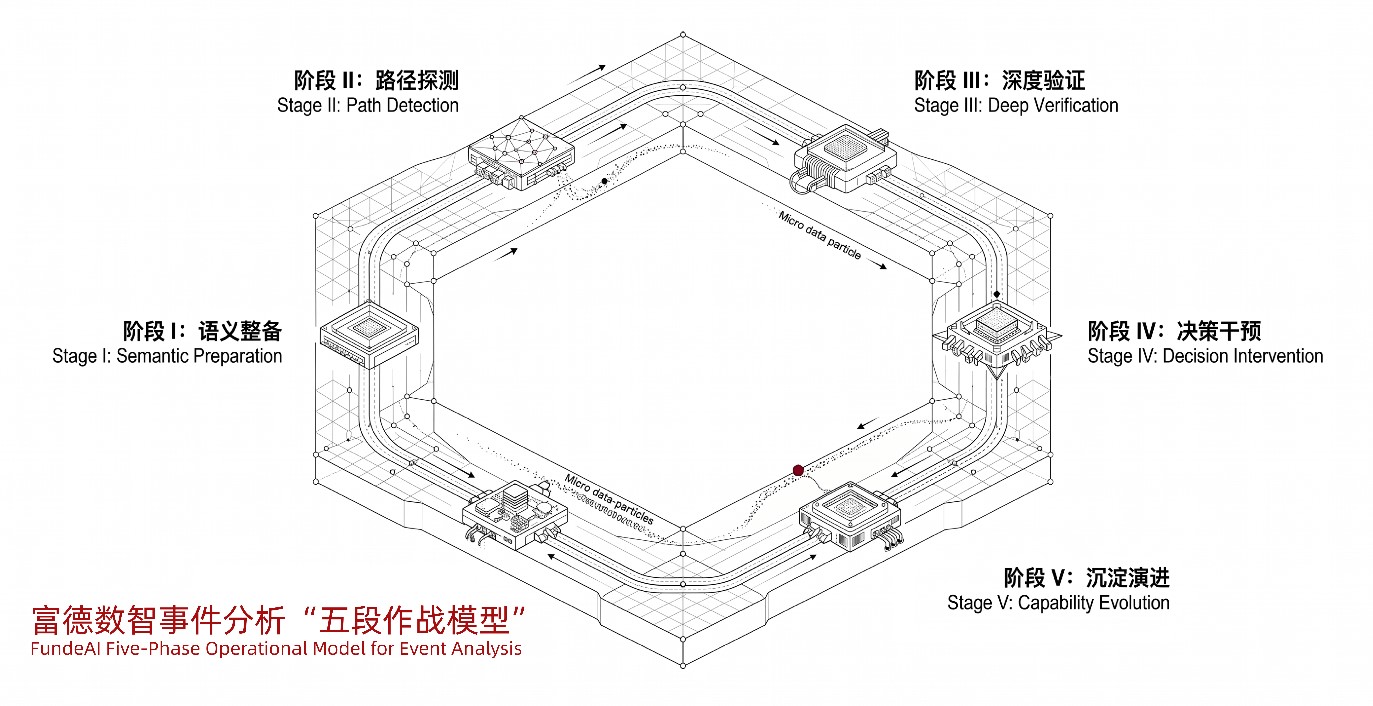
FundeAI Event Analysis “Five-Stage Combat Model”
If disassembled from the perspective of working mechanism, FundeAI has solidified the industry’s common methodology into the following five rigorous operational stages to ensure the reviewability of the analysis process and the authority of the results.
Stage I: Semantic Preparation and Ontology Mapping
Latest industry practice: Leading organizations have abandoned maintaining cumbersome data dictionaries and instead built “digital twin” business ontologies.
FundeAI mechanism: Relying on the Dezhen platform, unified business semantics are assigned to underlying original records. We transform fragmented numbers into “event contexts” with source, object, association, and environmental information. This ensures that analysts across departments and systems can collaborate seamlessly based on the same Single Source of Truth.
In this process, AI assists in entity extraction, relationship recognition, and semantic disambiguation, automatically aligning unstructured descriptions to the ontology model and significantly reducing manual preparation costs.
Stage II: Structured Correlation Exploration and Path Detection
Latest industry practice: Introducing timeline dimension (Chronicle) and multi-dimensional graphs to identify hidden interest transfers or risk transmission.
FundeAI mechanism: The core of the mechanism lies in revealing the relationship network hidden behind business data. Through dynamic graph technology, the system can automatically identify association paths between subjects and impact diffusion links. AI-driven graph neural networks and abnormal subgraph detection algorithms can complete automatic mining of implicit association paths in milliseconds, freeing analysts’ energy from “finding relationships” to “judging risks”, so that analysis is no longer limited to isolated abnormal points, but goes deep into the structural logic behind them.
Stage III: Evidence-Based Synthesis
Latest industry practice: Emphasizing the “auditability” of conclusions. Every judgment must be supported by atomic-level data, not vague sensory experience.
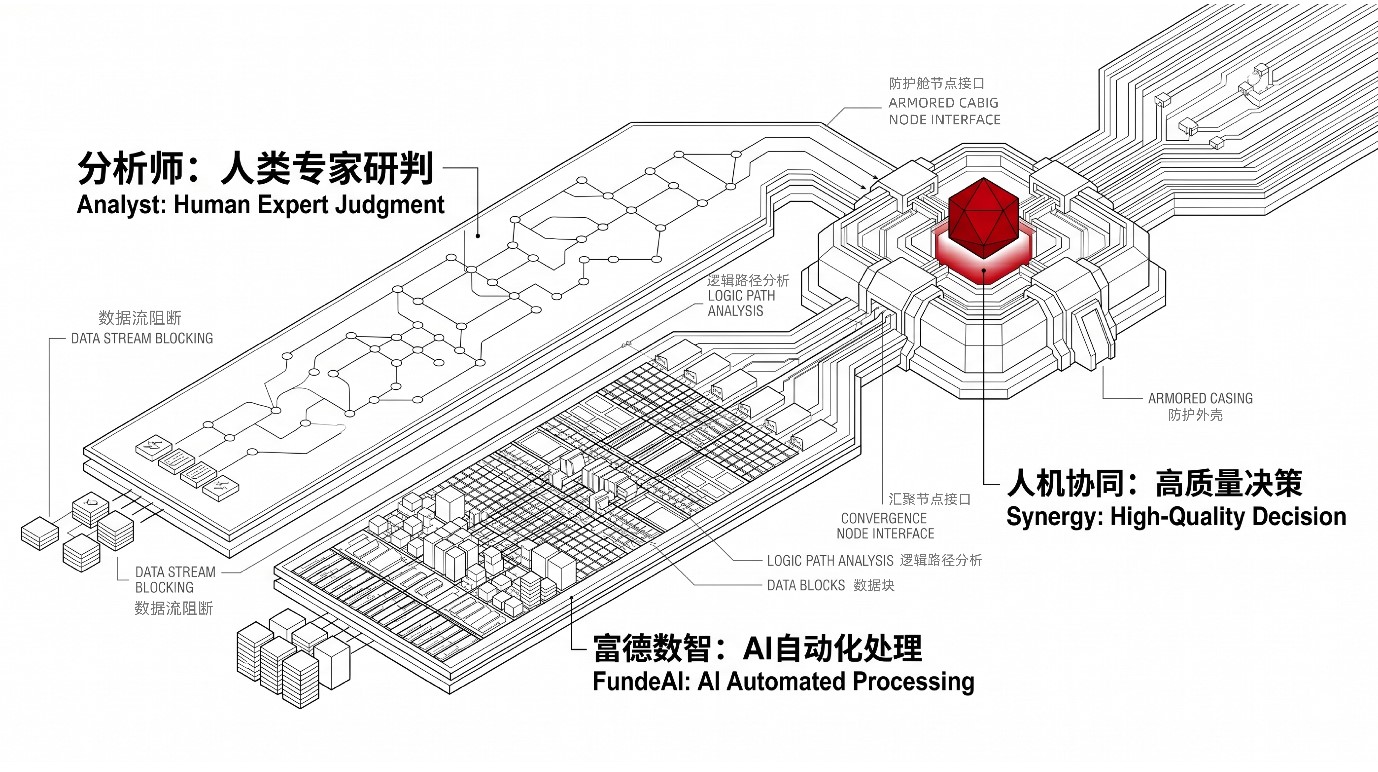
FundeAI mechanism: The Dezhi platform assists analysts in processing massive amounts of unstructured materials, summarizing clues, and forming investigation frameworks. In this mechanism, we strictly divide the human-machine boundary: AI large models are responsible for automatic reading, summarization, and contradiction point annotation, quickly generating preliminary research reports; graph algorithms are responsible for purifying high-value abnormal points and association paths from massive data. Algorithms are responsible for “discovering possibilities”, while humans are responsible for “making judgments”, qualitatively, verifying, and adjudicating clues based on experience and logic. All key conclusions must be based on a complete, atomic-level evidence chain, achieving interpretable, traceable, and verifiable conclusions.
Human-Machine Collaborative Decision-Making Framework
Stage IV: Decision Support and Business Execution Integration
Latest industry practice: “Closed-loop combat” has become a consensus. Analysis results are no longer static reports, but power directly injected into business flows.
FundeAI mechanism: Analysis conclusions trigger verification, approval, or early warning strategies in the business chain in real time. At this stage, AI assumes the role of policy routing and intelligent recommendation, automatically matching the optimal disposal process according to event type and confidence level, and providing real-time auxiliary decision-making suggestions during execution. This mechanism eliminates the transformation gap between the cognitive layer and the execution layer, allowing insights to be instantly transformed into actual actions that protect business security or drive business growth.
Stage V: Review Precipitation and Capability Evolution
Latest industry practice: Continuous learning mechanism. Automatically convert the experience of individual case disposal into algorithm features to promote the self-evolution of the defense system.
FundeAI mechanism: The end of the mechanism is the return of capabilities. Exponential progress in the industry requires full use of artificial intelligence capabilities. The AI continuous learning engine automatically converts the complete link of this disposal into new training samples and rule features, driving adaptive optimization of event perception thresholds, association model weights, and recommendation strategies, achieving exponential precipitation of organizational capabilities. Through backtracking of disposed events, we precipitate the judgment rules formed in the analysis process to the ontology platform, promoting the continuous iteration of the underlying model. After continuous accumulation, what the organization gains is not just a batch of cases, but a continuously evolving event analysis capability.
How FundeAI Supports the Event Analysis Closed Loop
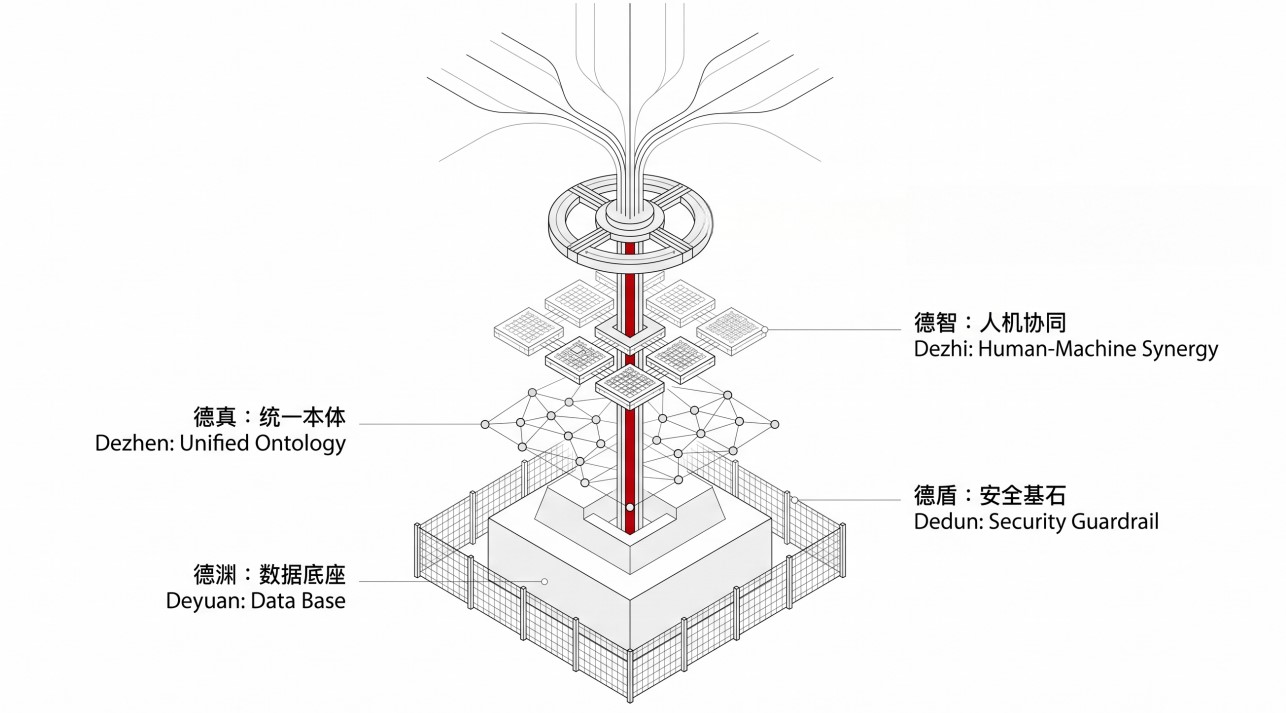
Supporting this mechanism is FundeAI’s complete technical system with artificial intelligence as the core engine. AI capabilities are deeply penetrated into every link of data, models, analysis, decision-making, and security.
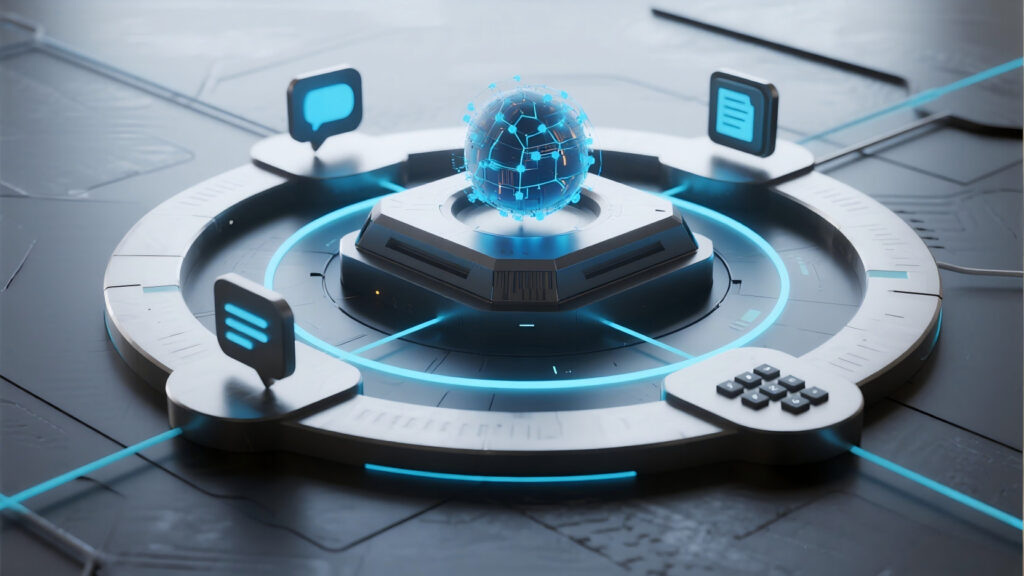
FundeAI Event Analysis Closed-Loop Technical System
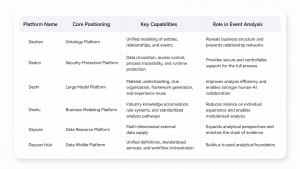
Among them, Dezhen is responsible for mapping entities, relationships, and events in complex businesses into a unified model. Through AI-driven entity extraction, relationship recognition, and ontology alignment technologies, it automatically converts fragmented data into structured business semantics, allowing the business structure hidden behind clues to be presented;
Dedun provides safe and controllable guarantees for the entire process of event analysis. Through AI-driven entity extraction, relationship recognition, and ontology alignment technologies, it automatically converts fragmented data into structured business semantics, ensuring a solid foundation for data circulation, authority governance, process traceability, and operational protection.
At the same time, AI is the core engine running through the entire event analysis process. Dezhi introduces large model capabilities into enterprise-level analysis scenarios, assisting analysts in material understanding, clue sorting, framework generation, and experience reuse. It serves to improve analysis efficiency and knowledge collaboration, rather than leaving critical judgments entirely to the model.
Deyuan, as the data middle platform, breaks down multi-source data silos and provides standardized and reusable data services and process orchestration through an AI-driven data quality diagnosis and intelligent orchestration engine, providing unified, credible, and efficient underlying data support for full-link event analysis;
Deshu, as the business model, uses an AI continuous learning mechanism to automatically extract high-frequency analysis patterns and expert rules, responsible for precipitating industry knowledge, rule systems, and analysis paths, so that event analysis gradually gets rid of high dependence on individual experience and moves towards modularization, systematization, and standardization.
At the same time, platform capabilities such as Deyuan, Delian, and Deming also participate in the construction of the event analysis system, providing collaborative guarantees in data resource supply, intelligent assistance, trusted collaboration, and AI applications and digital transformation respectively, forming a complete event analysis capability base for FundeAI.
FundeAI Event Analysis Capability Base
As event analysis evolves towards correlation mining, model collaboration, and real-time response, the importance of underlying support capabilities continues to increase.
What Changes Are Taking Place in Industry Practice
Over the past year, breakthroughs in artificial intelligence technology have driven a fundamental paradigm shift in the global event analysis field. These changes are no longer concepts in laboratories, but mature practices that have been implemented in leading enterprises in finance, energy, manufacturing and other industries. AI has changed from an “optional tool” to the “core base” of event analysis capabilities:
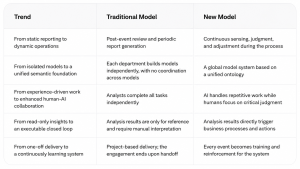
From “Post-Mortem Review” to “Real-Time Intervention”
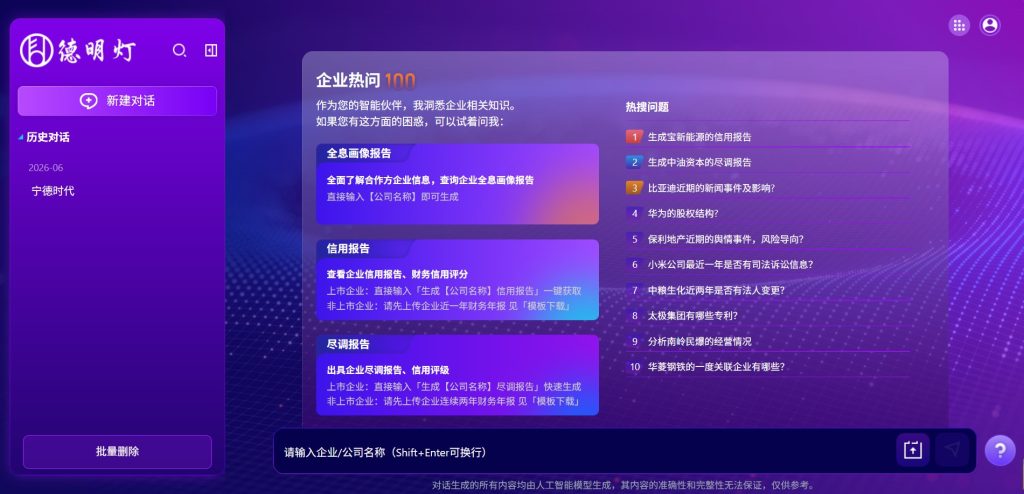
Traditional event analysis is “T+1 reports, weekly reports”, which can only do post-event accountability. The latest practice is second-level perception and minute-level response: through real-time data stream processing and edge computing, anomalies can be identified and interventions triggered the moment an event occurs. For example, in the financial anti-fraud scenario, Funde helps customers achieve real-time risk scoring and blocking during transactions through Deming Lamp, significantly reducing fraud loss rates. The maturity of AI real-time computing engines is the technical prerequisite for this transformation. Models no longer rely on batch processing, but complete feature calculation and risk scoring in milliseconds during transactions, making “second-level perception, minute-level response” the norm. In the future, event analysis will increasingly shift from “post-event fire fighting” to “pre-event prevention” and “in-event control”.
From “Data Splicing” to “Semantic Unification”
In the past, enterprises solved data silos by building data warehouses and moving data together, but the semantics of the data remained inconsistent—the same “customer” had different definitions in sales systems, financial systems, and customer service systems. Now, unified ontology has become an industry consensus. For example, the core of FundeAI’s Dezhen ontology platform is to use a set of standard models to describe entities, relationships, and events in the real world. Ontology learning and entity linking technologies driven by large models enable enterprises to automatically achieve semantic alignment of cross-system and cross-modal data without manually maintaining massive mapping rules. This is the fundamental solution to data silos and the basis for cross-departmental and cross-system collaborative analysis.
From “AI Replacement” to “Human-Machine Collaborative Enhancement”
The industry is moving out of the misconception of “large models are omnipotent”. The correct position of artificial intelligence in enterprise-level event analysis is also beginning to emerge—not replacement, but enhancement. More and more enterprises realize that large models cannot replace analysts in making critical judgments, but AI agents can provide capabilities beyond human limits in reasoning chain construction, multi-source information fusion, and hypothesis enumeration.
The latest human-machine collaboration model is: AI is responsible for standardized work such as data cleaning, initial clue screening, report generation, and knowledge retrieval, while human analysts focus on hypothesis construction, logical reasoning, evidence verification, and decision-making. Practice on the FundeAI platform shows that this model can increase the efficiency of individual analysts by 3-5 times while significantly improving the stability of analysis quality.From “Single-Point Disposal” to “Full-Link Closed Loop”In the past, event analysis was “analysis is analysis, business is business”, with an artificial wall between the two. The current trend is to build a fully automated closed loop of “perception-analysis-decision-execution-feedback”.Analysis results are no longer reports for reference only, but instructions that can directly drive business systems. When the system identifies a risk, it not only issues an early warning, but the AI agent also automatically generates executable disposal suggestions based on the event profile, assigns the optimal task responsible person, tracks execution progress, and dynamically adjusts subsequent strategies based on execution feedback. This upgrades the closed loop of event analysis from “process automation” to “intelligent self-adaptation”.From “Organizational Memory” to “System Memory”In the past, an enterprise’s event analysis capabilities “existed in people’s minds”, and personnel turnover would lead to loss of capabilities. The latest practice now is to transform personal experience into system capabilities. The spread of various skills and the normalization of “digital employees” are the best examples of this fact. AI allows organizational memory to migrate from the “human brain” to the “system brain”, achieving continuous accumulation and intergenerational inheritance of capabilities.
Industry Trend Change Table
Not a Tool, but a Mechanism
What FundeAI hopes to convey to the outside world is not a single technical capability, nor the value of a local tool, but a set of event analysis mechanisms that can operate for a long time in complex business environments. The core of this mechanism is not simply aggregating data, not simply building large screens, nor stopping at report generation, but truly connecting data, business, models, and actions. In an era where complexity is the norm, what event analysis capabilities compete on is no longer who has more data, but who can turn data into judgments faster, turn judgments into actions more steadily, and further precipitate actions into organizational capabilities. This is exactly FundeAI’s understanding of event analysis. It goes beyond discovering problems. It is more about driving action and continuously forming capabilities.
In this era where uncertainty is the norm, event analysis capability is no longer a special skill of a certain department, but the core competitiveness of the entire organization. A vendor that only sells tools can no longer gain a foothold in such an era. What FundeAI hopes to convey to the outside world is a set of event analysis working mechanisms that have been verified by a large number of actual combats and can operate for a long time in complex business environments. The core of this mechanism is not cool large screens, not massive data, nor advanced algorithms. It is to truly connect data, business, models, and actions, so that every discovery can drive action, and every action can precipitate into capabilities.
Seeing events is just the beginning;
driving action is the value;
continuous evolution is the ultimate goal.
FundeAI is committed to becoming a provider of digital economy infrastructure and an enabler of industrial intelligent development. We take “artificial intelligence + dynamic ontology” as the technical base, and “algorithms, computing power, data, security” as the core, serving multiple industries such as finance and insurance, energy and chemical industry, health management, and smart government affairs. Starting from cutting-edge scenarios, we transform technology into implementable business results, helping with risk control, efficiency improvement, and intelligent decision-making. We believe that the value of digital intelligence lies in solving complex problems in the real world.