






















FundeAI Key Topics
From building the foundations of AI infrastructure to advancing intelligent applications across industries, FundeAI focuses on key topics through ongoing technical exploration and practice—connecting data, logic, and real-world business needs.
Topics We Continue to Explore
Explore our perspectives on technical approaches, industry challenges, and pathways to real-world implementation.
Dynamic Ontology
Exploring how business entities, relationships, and rules continuously evolve in real-world contexts.
Large Mathematical Logic Models (LMLMs)
Exploring mathematical logic and complex reasoning to address hallucinations in large models.
Token Factory
Turning GPU resources into standardized token production capacity that can be measured and priced.
Three-Person Initiative (TPI)
Enabling collaboration among human, digital, and robotic agents in AI-powered insurance.
Enterprise Holographic Profile
Building a holistic understanding of enterprises through multidimensional data, relationships, and business conditions.
High-Quality Datasets
Focusing on data quality, governance mechanisms, and alignment with AI models and real-world applications.
AI for Industry
Exploring how AI capabilities can be integrated into real-world industry systems to create lasting value.
AI Infrastructure
Examining the foundational capabilities supporting model training, inference, and industry applications.
Dynamic Ontology
Business knowledge that evolves with real-world operations, rather than remaining a static description.
What It Is
Dynamic Ontology is an approach to organizing knowledge that continually evolves with the business environment, changing data, and new knowledge. It builds adaptable structures around business entities, relationships, and rules, helping systems understand business concepts and their connections while providing a foundation for further analysis and applications.
Why It Matters
Real business is always changing. Customer relationships, business rules, products, and processes continually evolve. Organizing and updating business knowledge reduces information silos and helps models and business systems understand changing situations more accurately than approaches that only record static information.
Business Applications
Connecting data with business understanding through knowledge organization, continuous updates, and intelligent applications.
Organize Business Knowledge
Identify business objects, attributes, relationships, and rules to build reusable knowledge structures.
Sense and Update Changes
Update knowledge relationships and business semantics as data and business conditions change.
Enable Reasoning and Applications
Provide structured knowledge to support business analysis and intelligent decision-making.
FundeAI in Practice
The DeZhen Dynamic Ontology Platform organizes business objects, rules, relationships, process logic, and domain knowledge into an understandable business network. In applications such as FundeLight, information from multiple sources establishes entity relationships and an analytical foundation for enterprise understanding and risk analysis.
Related Content
Technical Foundation
Explore Our Technology ↗Industry Applications
Explore Industry Solutions ↗Industry Perspectives
Read More Insights ↗Large Mathematical Logic Models (LMLMs)
Connecting semantic understanding, logical modeling, and domain knowledge to analyze complex business problems.
What It Is
Large Mathematical Logic Models (LMLMs) are an original framework developed by FundeAI. They integrate model capabilities with mathematics, logic, and business rules. Building on language understanding, structured knowledge, feature extraction, and logical reasoning express the relationships and constraints between business objects.
Why It Matters
Mathematical logic helps address hallucinations in large models. Industry problems often have clearly defined factual boundaries, decision criteria, and causal or risk-transmission relationships. Fluent answers must become evidence-based analysis, and models need industry knowledge to understand connections between data and risk signals.
Business Applications
Start with specific business questions and organize data, rules, and evaluation logic so model outputs can be traced to verifiable business evidence.
Organize Knowledge
Bring business objects, attributes, relationships, and rules into a unified framework.
Build the Logic
Use scenario-specific features for structured analysis and reasoning about relationships.
Form Judgments
Produce analysis and professional reports aligned with clearly defined business objectives.
FundeAI in Practice
While developing FundeLight, FundeAI implemented an innovative framework extending from Large Language Models (LLMs) to Large Mathematical Logic Models (LMLMs). Its starting point is the scaling law behind AI’s rapid development. By addressing Boltzmann machine challenges through Gibbs-based random sampling, the framework makes a paradigm shift from determinism to stochasticity. It also establishes an innovative approach that combines theory and practice to extract risk features in financial scenarios.
Related Content
Further Reading
From LLMs to LMLMs ↗Technical Foundation
Explore Our Technology ↗Industry Perspectives
Read More Insights ↗Token Factory
Turning computing resources into measurable, schedulable intelligent services that can be delivered consistently.
What It Is
A Token Factory organizes computing power for model inference and intelligent services. It connects hardware resources, model execution, scheduling, and service interfaces, turning underlying computing capabilities into measurable token supply and service capacity.
Why It Matters
Industry applications depend on more than the scale of available compute. Response speed, service quality, cost, and supply stability also matter. Token supply must align with model capabilities, data quality, and specific tasks to create business value.
Business Applications
Connect distributed resources into sustainable services through resource integration, service operations, and demand from industry applications.
Integrate Resources
Bring together diverse computing resources to support model execution.
Operate Services
Manage service efficiency and cost through optimization, scheduling, and metering.
Serve Industry Demand
Match industry application requirements and validate service quality and delivery outcomes.
FundeAI in Practice
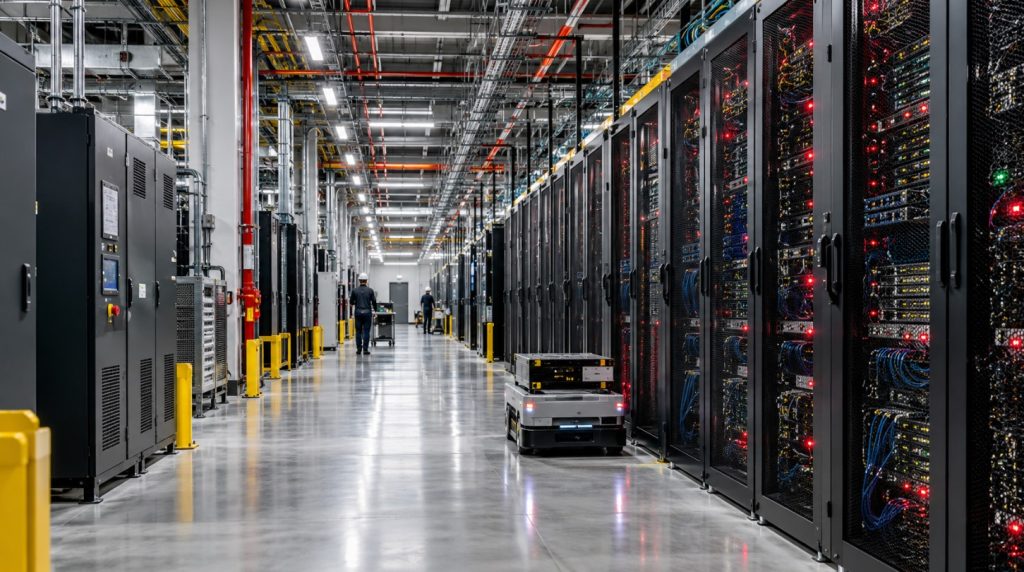
Drawing on the Group’s industrial ecosystem, FundeAI uses Token Factories to turn GPU hardware into standardized, measurable, and priceable token production capacity. This connects infrastructure supply with token consumption: building compute capacity, developing platforms, and ensuring delivery.
Related Content
Further Reading
From Compute to Token Supply ↗Technical Foundation
Explore Our Technology ↗Industry Perspectives
Read More Insights ↗Three-Person Initiative (TPI)
Collaboration among humans, digital humans, and robots in digital and intelligent insurance.
What It Is
The Three-Person Initiative (TPI) brings together three roles: humans provide professional judgment and take responsibility for services; digital humans support knowledge processing, information exchange, and tasks; and robots connect on-site sensing with execution. Together, they deliver coordinated capabilities for business services.
Why It Matters
Professional services require human experience, trust, and judgment, alongside continuous engagement and timely responses. Clear roles, knowledge foundations, and accountability boundaries help integrate intelligent tools into service workflows while keeping professionals in control of critical steps.
Business Applications
Begin with real service tasks, define roles, knowledge support, and feedback mechanisms, and gradually build collaborative workflows.
Professional Judgment
Humans handle critical communication, professional judgment, and service accountability.
Digital Collaboration
Digital humans provide knowledge retrieval, information exchange, and task assistance.
On-Site Connection
Robots connect on-site sensing and execution with human service workflows.
Putting It into Practice
FundeAI’s DeYu organizes business knowledge, service rules, and role assignments so humans, digital humans, and robots can collaborate within clearly defined boundaries.
Related Content
Further Reading
Watch the TPI Video ↗Technical Foundation
Explore Our Technology ↗Industry Perspectives
Read More Insights ↗Enterprise Holographic Profile
Build a complete understanding of an enterprise before making professional judgments for different financial scenarios.
What It Is
An Enterprise Holographic Profile brings together basic company information, ownership structures, financial and operating data, legal risks, public sentiment, and relationship networks around a single enterprise. It establishes a structured, interconnected foundation for understanding the business.
Why It Matters
No single metric can fully explain a company. Financial performance, operations, and external relationships need to be viewed in the same business context. Different financial scenarios also require different data dimensions and analytical logic, grounded in a shared set of facts.
Business Applications
Use a unified foundation for enterprise understanding to support distinct analyses for due diligence, equities, and fixed income.
Integrate Information
Connect enterprise information from multiple sources to build a consistent understanding of the entity.
Understand Relationships
Identify risk signals through company characteristics and relationship networks.
Adapt to the Scenario
Apply different analytical logic to investment research, equities, and fixed income.
FundeAI in Practice
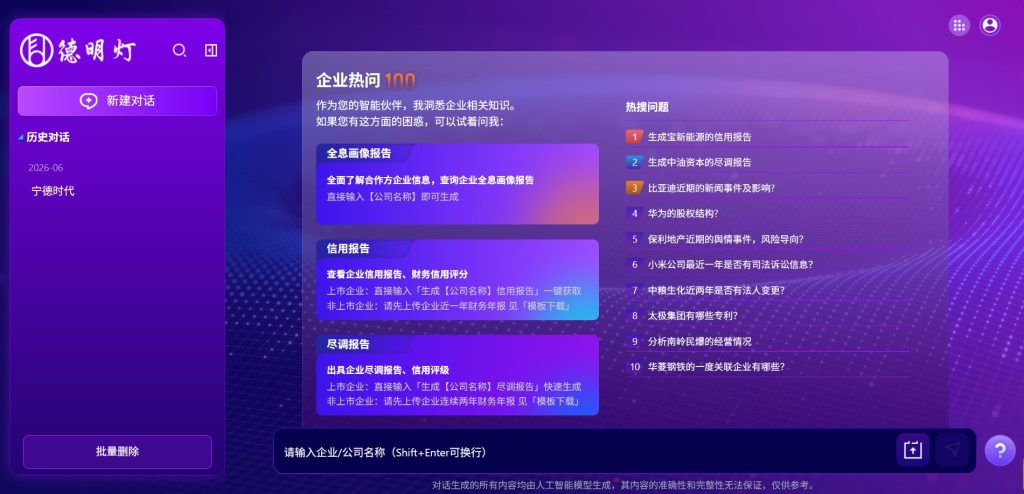
DeTu, a sub-platform of FundeLight, starts with an Enterprise Holographic Profile to support financial analysis, relationship identification, and risk-signal discovery. FundeLight’s “1+4” product suite connects this foundation with FD-Report, FD-Security, and FD-Fixed Income, applying a unified understanding to different financial questions.
Related Content
Further Reading
One Understanding, Three Financial Perspectives ↗Technical Foundation
Explore Our Technology ↗Industry Perspectives
Read More Insights ↗High-Quality Datasets
A foundation for business data that can be understood, accessed, verified, and continuously improved.
What It Is
High-quality datasets for Industrial AI go beyond collections of raw records. They align data definitions and business semantics with specific scenarios, organizing objects, relationships, and rules into data resources that models and business systems can use.
Why It Matters
Data volume alone does not determine usability. Fragmented sources, inconsistent semantics, and missing business relationships can weaken model understanding and application results. Data quality must meet governance requirements, model needs, and the demands of real business use.
Business Applications
Continuously refine source data into feature data and scenario-specific data, feeding application results back into dataset development.
Bring Data Together
Connect heterogeneous information from multiple sources and align business entities and definitions.
Build Reusable Capabilities
Combine Dynamic Ontology and algorithms to extract features and organize relationships.
Validate in Context
Use, verify, and continuously improve data through specific business tasks.
FundeAI in Practice
FundeAI uses DeZhen to organize business semantics, rules, and relationships. Across the Group’s diverse industries, we connect data with processes, strategies, and decision logic to build high-quality datasets, turning static records into reusable business capabilities.
Related Content
Further Reading
Building High-Quality Datasets ↗Technical Foundation
Explore Our Technology ↗Industry Perspectives
Read More Insights ↗AI for Industry
Helping models understand industry knowledge and business rules to create verifiable value in real workflows.
What It Is
AI for Industry combines model capabilities with industry knowledge, scenario-specific data, business processes, and clearly defined responsibilities. It focuses on integrating intelligence into production and operational systems, where it can be continuously validated and improved.
Why It Matters
Real industry problems involve specific entities, relationships, processes, and rules. General-purpose models provide a foundation; industry knowledge, data organization, and business mechanisms determine whether those capabilities can reliably support specific tasks.
Business Applications
Start with business objectives and build a connected path spanning data, knowledge, models, applications, and feedback.
Define the Scenario
Define the business task, target outcomes, and boundaries of responsibility.
Organize Knowledge
Turn industry experience, rules, and scenario data into a foundation models can use.
Validate Continuously
Integrate models into workflows and improve system capabilities through business feedback.
FundeAI in Practice
FundeAI builds an industrial intelligence system around “Dynamic Ontology + AI,” supported by computing power, algorithms, data, and security. Across finance and insurance, asset management, equity investment, AI infrastructure, health, real estate and property management, culture, and energy and minerals, we connect industry knowledge with business scenarios to build Industrial AI.
Related Content
Further Reading
Building Industrial AI Systems ↗Technical Foundation
Explore Our Technology ↗Industry Perspectives
Read More Insights ↗AI Infrastructure
Connecting computing power, models, data, and security through system efficiency to sustain industry applications.
What It Is
AI infrastructure comprises the foundational capabilities supporting model training, inference, and industry applications. Beyond computing, networking, and storage resources, it includes unified scheduling, model services, data governance, security, and operational assurance.
Why It Matters
Enterprises need AI tasks to be completed reliably, responses to arrive on time, and costs to remain manageable. The value of infrastructure is reflected in resource utilization, delivery efficiency, supply stability, security, and reliability.
Business Applications
From diverse resources to service operations and industry delivery, turn foundational capabilities into services that business teams can use.
Resource Supply
Organize diverse, adaptable computing resources.
Unified Scheduling
Connect task distribution, service metering, and model execution.
Industry Delivery
Support applications with industry knowledge, data, and security requirements.
FundeAI in Practice
FundeAI develops foundational Industrial AI capabilities through the coordinated Four Beams. DeShang integrates diverse computing resources through unified management and intelligent scheduling, providing stable, efficient support for large-model training, inference, and industry applications. Platforms such as DeZhi and DeZhen further connect models with business.
Related Content
Further Reading
Industrial AI Computing Infrastructure ↗Technical Foundation
Explore Our Technology ↗Industry Perspectives
Read More Insights ↗Continuous Research. Continuous Practice.
Deepening our understanding and capabilities by addressing the key challenges of industrial digital intelligence.