























After WAIC: As AI Moves from the Digital World into the Physical World, What Is FundeAI Doing?
Recently, the 2026 World Artificial Intelligence Conference and High-level Meeting on Global AI Governance was held in Shanghai. President Xi Jinping attended the opening ceremony and delivered a keynote speech, clearly stating that artificial intelligence is moving from the “digital world” into the “physical world.” He called for comprehensive efforts to advance AI technological innovation, industrial development, and scenario-based application, while coordinating the transformation and upgrading of traditional industries so that AI can empower a wide range of sectors.
The speech also emphasized that AI should become a trustworthy tool for humanity, and that legal and regulatory systems, technical monitoring, risk warning, and emergency response mechanisms should be developed to ensure that AI remains safe, reliable, and controllable.
Together, these two points indicate the next stage of AI development: AI must not only enter real industries and practical business operations, but also establish trustworthy, secure, and controllable operating boundaries. Beyond technological breakthroughs, industrial implementation and safety governance are becoming equally important priorities.
When AI truly enters industry, the key to whether it can create real value lies in the shift from the “digital world” to the “physical world.”
Opening of the 2026 World Artificial Intelligence Conference and High-level Meeting on Global AI Governance
Image source: China Daily
From the Digital World to the Physical World: The Coordinates of AI Development Are Changing
In recent years, especially during the rapid development of large models, public discussion around AI has focused more on parameter scale, training data, and generative capabilities. Application hotspots have also largely centered on digital environments such as text, images, search, and content generation.
Today, as AI further enters devices, systems, organizations, and business processes, its connection with the “physical world” is clearly deepening.
AI is increasingly expected to participate in analysis, judgment, scheduling, early warning, and execution. Its outputs may directly affect a business decision, a flow of funds, a production-line schedule, or the operating status of a device. This is not only an increase in technical difficulty, but also a fundamental reconstruction of reliability, real-time performance, and security.
This shift was fully reflected in the conference agenda.
According to statistics from Economic Information Daily, among approximately 172 meetings, forums, and events at this year’s conference, the tag “industrial development” appeared 51 times, “talent ecosystem” appeared 30 times, and “computing power” appeared 28 times. Among forums focused on industrial development, transportation, industry, and finance accounted for 6, 5, and 4 related forums respectively. The focus of the conference has moved beyond pure technological breakthroughs toward the integration of AI with specific industries and scenarios.
At the same time, once AI begins connecting to business systems and real-world equipment, its impact is no longer limited to content generation. It also involves business decisions, system permissions, data flows, and real-world execution. Trustworthy security is no longer an add-on capability, but a basic threshold for AI to enter industry.
Viewed together, the signals released by this year’s conference point to a clear trend: the coordinates of AI development are undergoing a threefold shift: from information generation to real business operations, from technology demonstrations to industrial scenarios, and from “usable” to “trustworthy and controllable.”
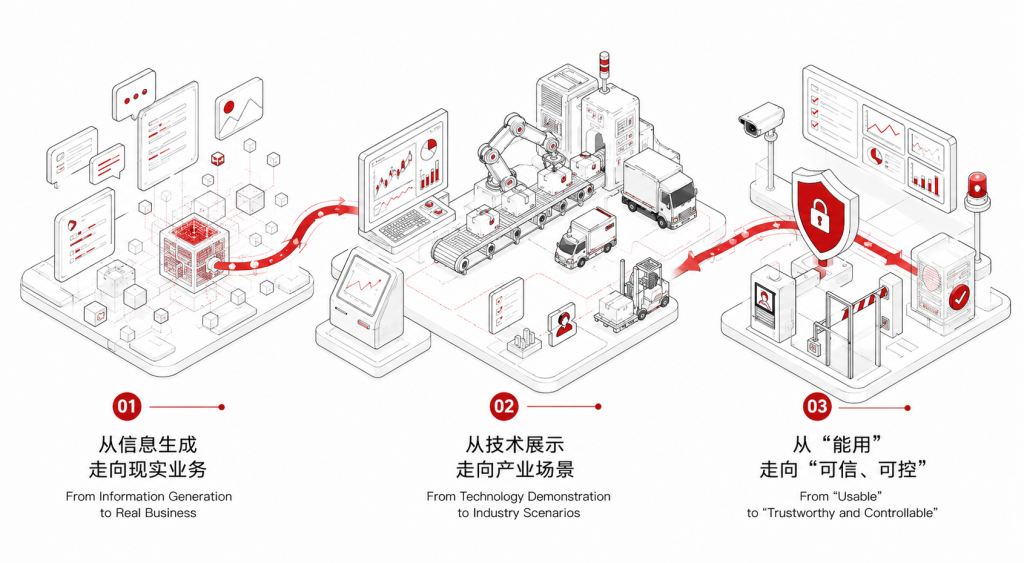
The Changing Coordinates of AI Development
Industrial AI Is Becoming a Systems Engineering Challenge
For AI to move from the digital world into the physical world, it cannot rely on model capability alone.
Industrial practice over the past several years has repeatedly confirmed one fact: a model that performs well on general benchmarks often encounters issues in specific industries, such as incompatible data formats, mismatched business rules, disconnected system interfaces, and unclear security permissions. None of these problems can be solved by model upgrades alone.
Industrial AI requires a set of coordinated system capabilities. At minimum, these capabilities include four core dimensions: computing power, algorithms, data, and security.
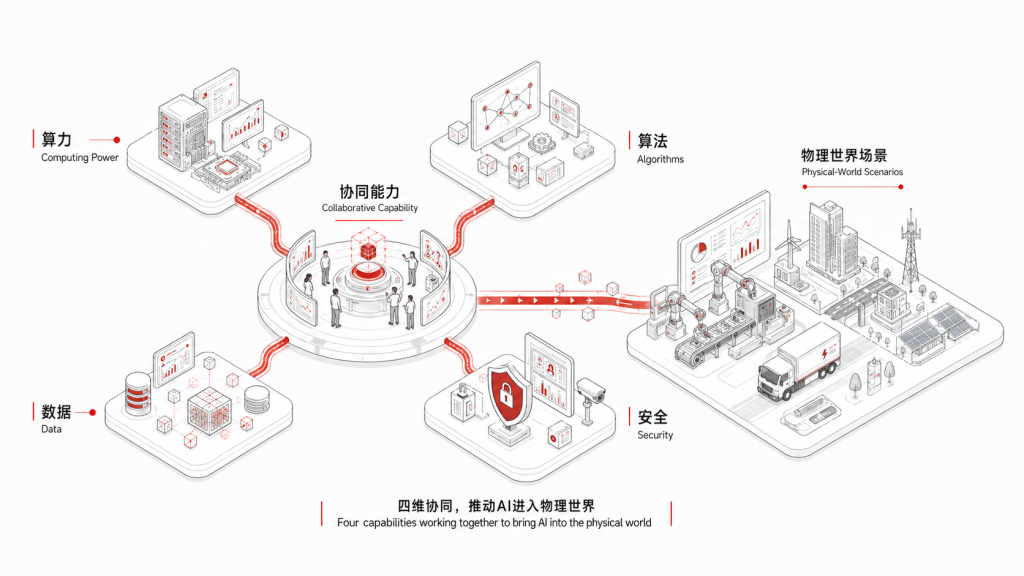
Industrial Intelligence: Four-Dimensional Coordination
Computing power is the foundation that supports AI’s stable entry into production environments.
Different industries have different requirements for computing scale, response speed, and deployment methods. Some real-time risk control and trading scenarios require millisecond-level responses, while industrial quality inspection and equipment control scenarios may require low-latency inference at the edge.
Computing power determines whether AI can move from demonstration environments into production environments. This year’s conference listed computing power as a high-frequency topic, and the AI Cooperation and Development Action Plan also explicitly proposed inclusive access to intelligent computing power.
Algorithms are evolving from general-purpose models toward industry-specific tasks.
Large models provide general cognitive capabilities, but once they enter industry, they must also understand industry rules, business goals, and task workflows. At this year’s conference, agents became the theme of more than 10% of forum sessions, and four of the ten featured “treasures of the exhibition” were agent products.
The essence of the attention on agents is that AI is moving from “answering questions” to “completing tasks.” This requires task planning, tool use, system connectivity, long-term memory, and collaboration mechanisms, not just model capability.
Data is the prerequisite for AI to truly understand industry.
Industrial data is often scattered across different systems and formats. Without unified governance and semantic connections, AI cannot accurately understand business context.
The supply of high-quality datasets, data governance, business semantic modeling, and knowledge association are all thresholds that AI must cross as it moves into industry.
Security establishes trustworthy operating boundaries for AI.
In industrial scenarios, it is not enough to determine what AI can do. It is also essential to define what AI must not do. Permission boundaries, data security, abnormal behavior monitoring, decision traceability, and full-lifecycle governance are all foundational mechanisms that industrial AI must establish.
Computing power, algorithms, data, and security are not four separate technical tracks. They are coordinated capabilities required for AI to move from the digital world into the physical world.
The AI Cooperation and Development Action Plan incorporates data, computing power, enablement, and security into the same system. This further reflects a policy direction in which AI development is moving from breakthroughs in single-point capabilities toward coordinated progress across data, computing power, applications, and governance.
In the same direction, FundeAI is building a capability system for industrial intelligence.
The four dimensions discussed above, computing power, algorithms, data, and security, are precisely the practical questions that must be answered one by one for industrial AI implementation.
As the coordinating and implementation organization for Funde Group’s AI and digital intelligence strategy, FundeAI is building a complete capability system from strategy to scenarios along these four main lines.
To achieve this goal, FundeAI has established an overall framework of “Four Beams x Eight Pillars.”
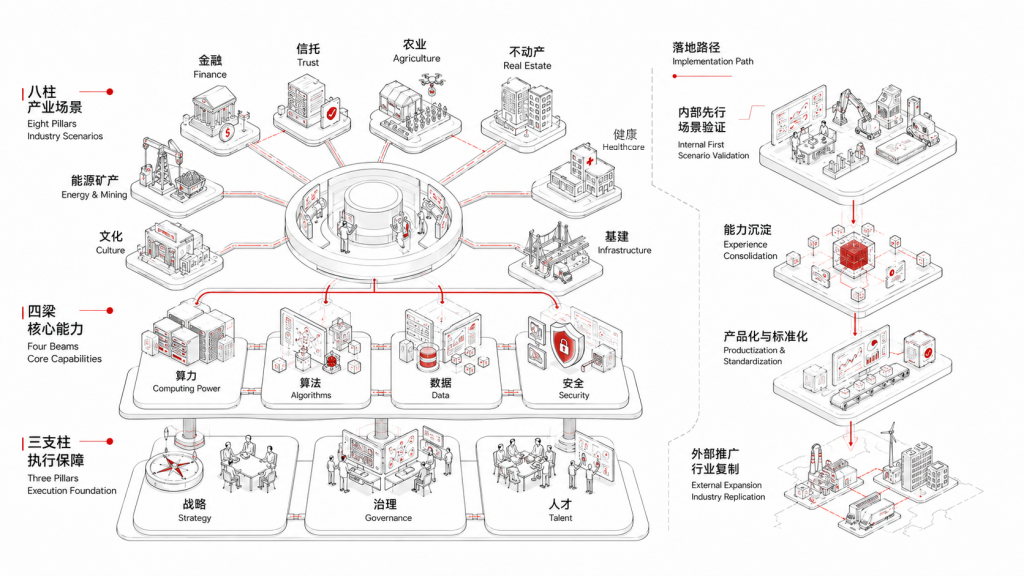
FundeAI: Four Beams x Eight Pillars
The Four Beams, computing power, algorithms, data, and security, are the core capabilities that support AI’s entry into industry.
In computing power, FundeAI combines self-built capabilities with ecosystem partnerships to support the long-term stable operation of AI.
In algorithms, it transforms general-purpose large models into solutions that understand industries and business operations.
In data, it uses governance, dynamic ontology, and business semantic modeling to turn scattered industrial data into business knowledge that AI can understand.
In security, it builds trustworthy boundaries around data, permissions, behavior, and operating processes.
The Eight Pillars are what fundamentally distinguish FundeAI from purely technical vendors: Funde Group’s real industrial scenarios across finance, trust, agriculture, real estate, energy and mining, culture, health, infrastructure, and other fields.
These scenarios are not only sources of demand and suppliers of data, but also testing grounds for AI capabilities and engines for iterative feedback. Industrial AI is not built in a lab and then pushed into industries; it grows out of industrial soil.
In its implementation rhythm, FundeAI follows the principle of “internal-first, external-next.” It first validates AI capabilities and business value within the ecosystem, then turns mature experience into standardized products and services for external promotion.
What FundeAI is doing is weaving strategy, organization, technology, and industrial scenarios into an organic whole that can operate, evolve, and create value. This is an active response to AI’s movement from the digital world into the physical world.
As AI enters industry, the real competition is only just beginning.
The continued advancement of model capabilities remains important. However, whether AI can truly enter industry no longer depends on any single model alone. It depends on whether computing power, algorithms, data, security, and business scenarios can be organized into a system that runs continuously, improves constantly, and creates value.
The signal from the World Artificial Intelligence Conference is already very clear: AI is moving from the digital world into the physical world, and the focus of industrial competition is shifting from single-model capability to system capability.
The system capabilities that FundeAI is building around computing power, algorithms, data, and security, as well as its implementation practices across diverse industrial scenarios, are inherently aligned with this trend.
As AI leaves the digital world and enters industry, what is needed is a systematic answer that can connect strategy, organization, technology, and scenarios.
FundeAI will continue moving in this direction, promoting the deep integration of AI with industrial scenarios so that intelligent capabilities can truly enter business operations, serve industries, and create value.
About FundeAI
FundeAI is committed to becoming a provider of digital economy infrastructure and an enabler of industrial intelligence development.
With “AI + dynamic ontology” as its technological foundation, and with “algorithms, computing power, data, and security” at its core, FundeAI serves multiple industries including financial insurance, energy and chemicals, health management, and smart government. Starting from frontier scenarios, FundeAI turns technology into practical business outcomes, helping improve risk control, efficiency, and intelligent decision-making.
We believe the value of digital intelligence lies in solving complex problems in the real world.