































DeZhen Dynamic Ontology: The Cornerstone of Trustworthy AI Decision-Making
The Decision-Making Dilemma of Static Forms: The Fundamental Bottleneck in the Era of Complex Interconnections
- Integration Barriers for Multi-Source Heterogeneous Data
Enterprise operational data is scattered across ERP, CRM, logistics, supply chain and other systems, with completely disconnected formats, standards, and semantics. Static forms cannot assign unified business semantics to dispersed data, resulting only in data silos. Decision-makers cannot obtain a globally consistent business view.
- Adaptation Failure for Dynamic Business Operations
The correlation rules of static architectures are pre-set upfront. When new business scenarios, new cooperation entities, or new risk factors emerge, enterprises must restructure table schemas and rewrite correlation logic, leading to long development cycles and high trial-and-error costs, with decision-making always lagging behind market changes.
- Blind Spots in Deep Correlation Mining
Static forms can only handle preset explicit correlations, and have no ability to penetrate hidden “dark thread” relationships, such as supply chain transmission impacts and implicit interest bindings between entities. Decision-making can only stay at the surface level, unable to anticipate risks or uncover opportunities.
DeZhen’s Core Paradigm: A Semantic, Real-Time, Evolvable Relational Intelligence Engine
-
Semanticization: Turning Cold Data Symbols into Consensual Business Knowledge
DeZhen’s core capability is breaking down the language barrier between IT and business operations. It maps scattered multi-source heterogeneous data to entities and relationships with clear business meaning – for example, converting database field codes into business objects directly understandable by decision-makers, such as “raw material mine”, “lithium mine supplier”, and “supply relationship”. This turns data from symbols only interpretable by technical personnel into business knowledge that is consensual and reusable across the entire enterprise. This unified model fundamentally eliminates cross-departmental discrepancies in data standards, enabling procurement, supply chain, risk control, and strategy teams to work from a single business view.
-
Real-Time Responsiveness: Aligning Analytical Insights with Business Flow Evolution
Static form-based decision-making is essentially built on historical data processed in batches after the fact. DeZhen achieves full synchronization of data updates, relationship calculation, and insight generation with business workflows. Changes to entity attributes, fluctuations in correlation relationships, logistics track updates, and market data changes can all be mapped to the dynamic ontology model in real time. Decision-makers always see the latest global business picture, rather than lagging weekly or monthly reports. Whether it is a sudden supply chain fluctuation or an abnormal transaction by a market entity, it can be captured and presented in real time, supporting proactive and agile decision-making.
-
Evolvability: A Flexible Architecture Without Overhaul, Protecting Enterprise Data Sovereignty
DeZhen completely breaks the rigid dilemma of “business changes trigger a full architecture overhaul”. When new business problems, data sources, or correlation rules emerge, there is no need to restructure the underlying data architecture. Simply by extending the ontology’s entities, relationships, and attributes, new elements can be quickly integrated into the existing knowledge system to support agile analysis for new scenarios.
At the same time, the platform seamlessly connects to an enterprise’s existing data warehouses, business systems, and data lakes. It overlays relational intelligence capabilities without damaging existing data assets and pipelines, maximizing the protection of an enterprise’s existing IT investment and data sovereignty. Unlike general standardized solutions, DeZhen allows enterprises to build proprietary domain knowledge models for different scenarios such as risk control, market insight, and supply chain analysis, aligning data capabilities fully with personalized business needs.
End-to-End Value Deduction: How DeZhen Reinvents Supply Chain Decision-Making for Global Manufacturing
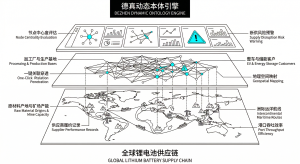
DeZhen Panoramic View of Lithium Battery Supply Chain Decision-Making
-
Global Ontology Modeling to Build a Unified Business View
DeZhen completes end-to-end dynamic ontology modeling for the supply chain, precisely defining all business entities and correlation relationships, while supporting unlimited attribute addition to nodes and edges. All business details – from mine production capacity and supplier performance records to shipping route cycles and port throughput efficiency – are fully recorded without any information omission. The platform’s visual dashboard automatically presents core graph statistics, including the total number of end-to-end nodes and the distribution ratio of edge relationships. Decision-makers can grasp the full scale and core structure of the supply chain at a glance, without consolidating reports from dozens of departments.
-
One-Click Correlation Penetration to Break Hierarchical Information Barriers
Decision-makers can quickly locate core entity nodes through search and view complete business attributes; with one click to trigger relationship expansion, the full chain of upstream and downstream associated entities and relationship attributes of the node are completely presented. In the traditional model, this full-chain penetration process requires cross-departmental collaboration and takes weeks; on the DeZhen platform, it can be completed with a single click, completely breaking the hierarchical barriers of information transmission.
-
Diversified Visual Layouts to Precisely Locate the Core Context of the Network
For million-level node and relationship networks, DeZhen provides 8 professional graph layouts (force-directed layout, circular layout, grid layout, GPU layout, etc.), which can be dynamically adapted to different data types. In supply chain scenarios, the force-directed layout can clearly present the hidden hierarchical relationships and key nodes of the supply chain through spatial distribution, helping decision-makers quickly locate the core context of the network and identify the core hubs for full-chain stability. At the same time, the platform supports one-click filtering of different types of nodes and edges, enabling separate viewing of specific enterprise nodes, production factories, or locking of specific relationships such as supply and technical cooperation, to quickly focus on core objects of interest in complex networks.
-
Geospatial Visualization for Global Situation Awareness
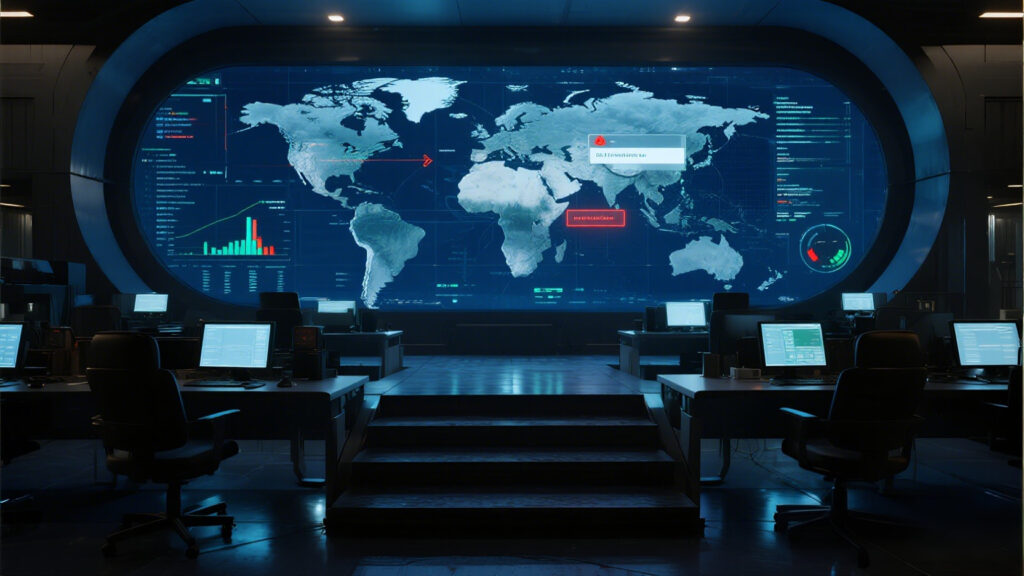
DeZhen’s map visualization function can accurately map all supply chain data points to a global map. Whether it is intercontinental ocean routes, inland freight tracks, raw material origins, production factories, or global port nodes, all can be clearly visualized. The aggregation degree of nodes on the map can intuitively show the distribution of logistics hubs and industrial clusters. Managers can identify high-traffic key nodes of the full supply chain at a glance, while monitoring logistics track abnormalities in real time, and quickly assessing the scope of impact of route delays and road section controls on the entire chain.
-
Quantitative Evaluation of Core Nodes + AI Hidden Thread Mining for Proactive Risk Prediction
DeZhen has powerful node centrality calculation capabilities, which can quickly calculate key indicators such as degree centrality, betweenness centrality, and closeness centrality for all nodes in the full graph, precisely quantifying the importance of each node in the supply chain network. This helps enterprises identify the “chokepoints” of the full chain, formulate backup plans in advance, and fundamentally avoid supply disruption risks.
At the same time, relying on AI algorithms, DeZhen can automatically complete and expand the correlation relationships between entities, and mine the hidden “dark threads” in the data – such as shared upstream mines between suppliers, potential compliance risks of secondary suppliers, and other hidden connections that cannot be found in the traditional model. These are fully visualized, helping enterprises identify risks in advance and seize market opportunities.
White-Box Decision-Making: A Revolution in Decision Ethics and Efficiency in the Era of Relational Intelligence
- Market Regulation Scenario: DeZhen helped build an enterprise correlation risk insight network, delivering over 80% improvement in the efficiency of abnormal transaction pattern investigations, and accurately identifying multiple hidden illegal operations and related parties.
- Financial Risk Control Scenario: Helped large commercial banks achieve in-depth visibility into group clients and complex guarantee circles, realizing an order-of-magnitude improvement in the identification and early warning efficiency of high-risk credit businesses.
- Economic Crime Investigation Scenario: Relying on dynamic ontology and pattern matching capabilities, it quickly locates money laundering paths and fraud gangs in hundreds of millions of transaction data, reducing evidence chain sorting time from weeks to hours.